Patients are no longer just searching for health information. Increasingly, they are asking AI.
A patient who once might have spent weeks moving from symptoms, to diagnosis, to treatment research, to clinical trial options, can now ask one conversational question: "Are there any clinical trials for someone like me?"
For clinical trial teams, this changes the recruitment challenge. The goal is no longer only to rank in search results. The goal is to make a trial answerable in AI-generated summaries.
From Search Ranking to AI Answerability
Traditional search rewards content that can be found and ranked.
AI search rewards content that can be understood, trusted, and cited.
That creates a new recruitment reality: patients may discover, compare, and evaluate clinical trial options inside one AI conversation. This compresses a journey that once took weeks into minutes.
To be included in that journey, trial content must be clear enough for patients and structured enough for AI systems.
Why Trials Are Invisible to AI
Many clinical trials are online but not AI-ready.
The issue is not always lack of information. It is often that the information is fragmented, overly technical, inconsistent across sources, or written for compliance rather than patient understanding.
AI systems look for two types of trust signals.
1. Machine Trust: Can AI Verify The Trial?
Machine trust helps AI determine whether trial information is credible, structured, and consistent.
Strong machine-trust signals include:
- A complete ClinicalTrials.gov record: The trial record should be accurate, current, and aligned with all patient-facing materials.
- Structured eligibility criteria: Inclusion and exclusion criteria should be easy to parse and, where possible, written in plain, testable statements.
- Consistent terminology: The trial name, condition, intervention, sponsor, phase, and NCT number should match across ClinicalTrials.gov, sponsor pages, recruitment sites, and campaign materials.
- Answer-shaped content: A plain-language FAQ should answer the questions patients are likely to ask: Who may qualify? What does participation involve? What happens after I inquire? What should I ask my doctor?
- Verifiable evidence: Links to ClinicalTrials.gov, PubMed, institutional partners, published protocols, or advocacy organizations strengthen citation readiness.
2. Patient Trust: Can Patients See Whether It Is Relevant?
Patient trust helps a potential participant understand whether the trial is right for them.
Strong patient-trust signals include:
- Fit signals: Use plain language to describe the ideal candidate by diagnosis, age, stage, severity, or prior treatment history.
- Treatment-journey context: Clarify whether the trial is for newly diagnosed patients, patients after treatment failure, chronic condition management, or another specific situation.
- Burden clarity: Explain time commitment, visit frequency, location, remote or in-person requirements, and reimbursement information where applicable.
- Risk transparency: Present safety information clearly and early, with language patients can understand.
- Ease of action: Make the next step obvious: pre-screen, call, email, speak with a doctor, or wait for a coordinator response.
The AI Trust Ladder For Clinical Trials
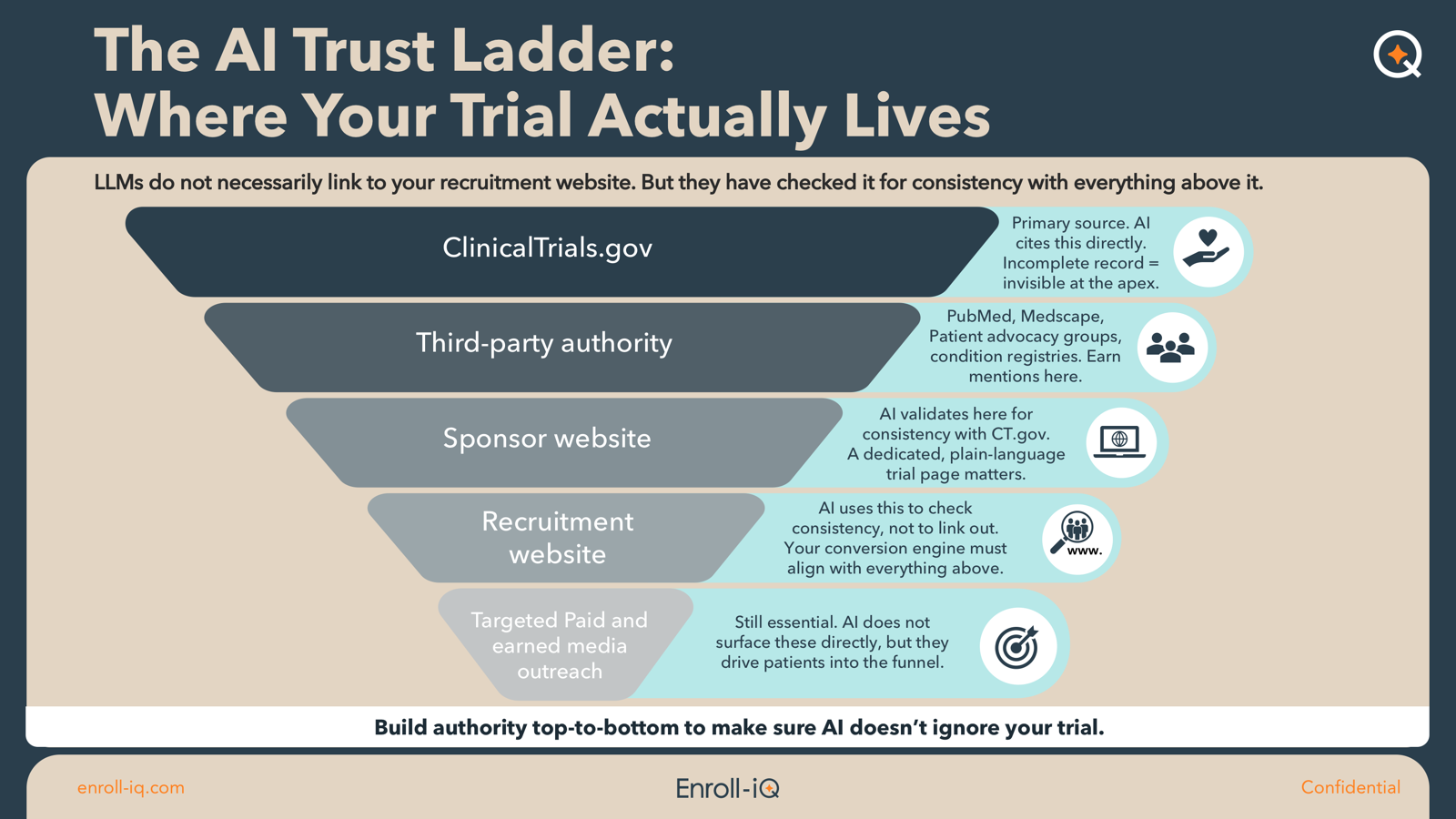
AI systems do not treat all sources equally. They tend to prioritize information based on authority and consistency.
For clinical trials, visibility should be built from the top down:
- ClinicalTrials.gov: the primary authority layer
- Third-party authority: PubMed, medical centers, advocacy groups, professional societies
- Sponsor website: plain-language trial explanation and study context
- Recruitment website: patient-friendly conversion and next steps
- Paid and earned media: reach, reinforcement, and discovery
A recruitment campaign cannot fully compensate for weak authority signals. If ClinicalTrials.gov, the sponsor site, and recruitment site do not align, AI may hesitate to cite the trial.
The First Answer Readiness Framework
EnrollIQ's First Answer Readiness Framework helps trial teams evaluate whether their study is ready to appear in AI-generated patient answers.
It focuses on three dimensions:
- Clarity: Can patients understand the study, eligibility, risks, burden, and next steps?
- Structure: Can AI systems parse the page through clean formatting, FAQs, schema markup, metadata, and consistent terminology?
- Authority: Can the information be traced to credible sources such as ClinicalTrials.gov, sponsor pages, PubMed, medical centers, or advocacy partners?
The goal is not just to be visible. The goal is to be understandable, verifiable, and citation-worthy.
5 Actions Trial Teams Can Take Now
Improving AI visibility does not require a new platform or major budget. Start with these five steps.
1. Audit Your Trial In AI Search
Ask patient-like questions across AI platforms:
- "Are there clinical trials for [condition] near me?"
- "Is there a study for patients who have tried [treatment]?"
- "What trials are available for [diagnosis]?"
- "Am I eligible if I have [condition] and [treatment history]?"
Check whether your trial appears, how it is described, and which sources are cited.
2. Review The ClinicalTrials.gov Entry
Make sure the record is complete, current, and consistent with all other trial materials.
3. Write A Plain-Language Candidate Profile
Describe who the study may be right for without jargon.
Example:
This study may be relevant for adults diagnosed with [condition] who have previously received [treatment] and are exploring additional options.
4. Check Terminology Consistency
Confirm that trial name, NCT number, condition, intervention, sponsor, phase, locations, and recruitment status match across all digital assets.
5. Clarify The Next Step
Explain what happens after a patient expresses interest: pre-screening, coordinator follow-up, expected response time, physician discussion, or site contact.
The New Recruitment Reality
Clinical trial recruitment has always depended on trust. What has changed is where that trust is first formed.
Increasingly, a patient's first encounter with a trial may happen inside an AI-generated answer.
The trials that succeed in this environment will not simply be the ones with the biggest media budget. They will be the ones that are easiest to understand, easiest to verify, and easiest for AI to include in the first answer.